

New Delhi/Washington:
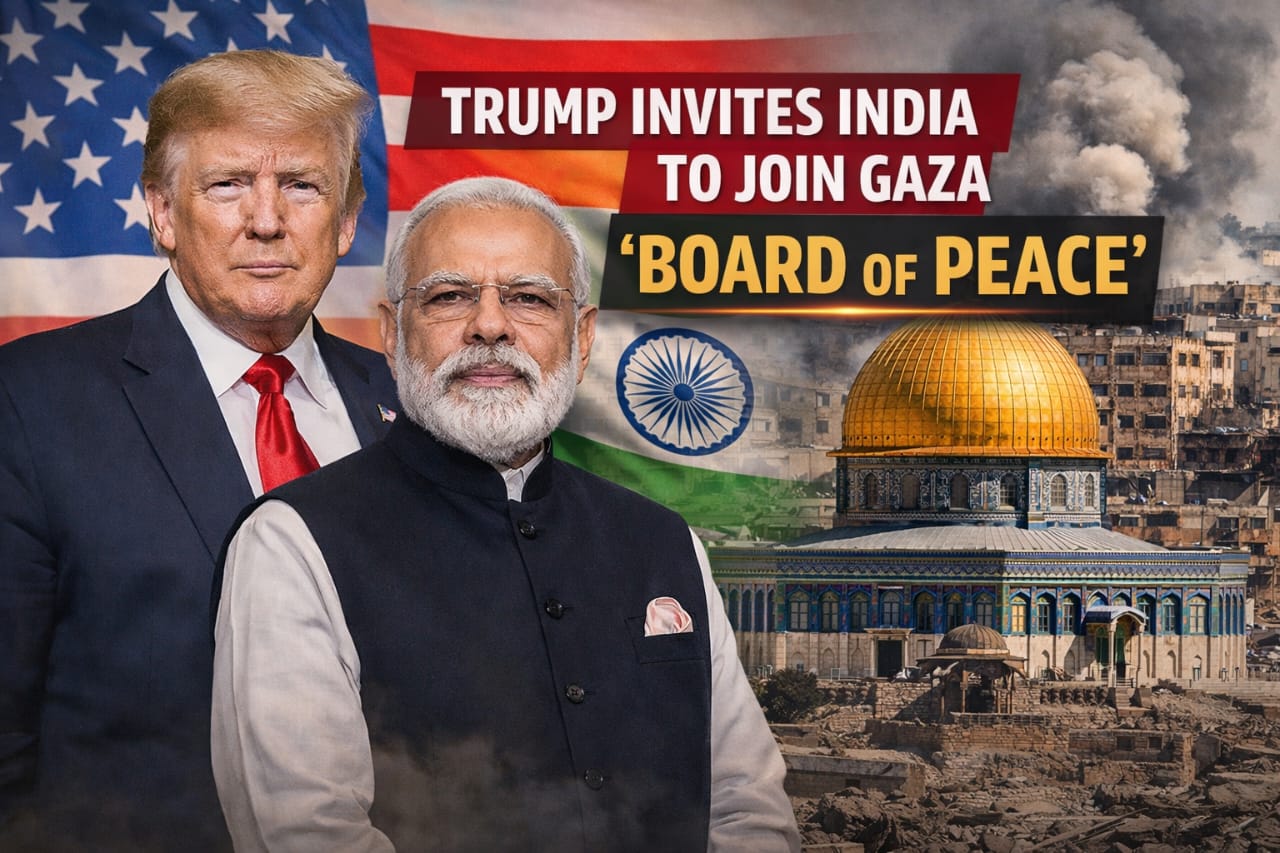
Why Trump invited India for Gaza peace board In a significant diplomatic development, former US President Donald Trump has invited India to become part of a proposed international body known as Gaza’s “Board of Peace”, aimed at overseeing governance, reconstruction, and long-term stability in post-war Gaza. According to sources cited by NDTV, the initiative is part of Trump’s broader 20-point peace plan announced earlier this month.
The proposal has sparked global attention, with governments reacting cautiously amid concerns about its potential overlap with existing United Nations mechanisms. However, India’s inclusion is being viewed by many analysts as a strategic and symbolic move, given New Delhi’s longstanding ties with both Israel and Palestine.
What Is the “Board of Peace” for Gaza?
The Board of Peace is envisioned as a multi-layered international governance framework designed to guide Gaza’s political transition and reconstruction after years of conflict. The White House outlined that the structure would consist of three key components:
1. Main Board of Peace – Chaired by Donald Trump himself, responsible for overall direction and international coordination.
2. Palestinian Technocratic Committee – A body of non-political experts tasked with administering Gaza’s day-to-day governance.
3. Executive Advisory Board – A secondary panel intended to provide policy guidance, diplomatic outreach, and regional coordination.
While the White House has not yet detailed the exact powers or responsibilities of each board member, officials indicated that additional countries would be named in the coming weeks.
Why India’s Role Matters
India is widely regarded as one of the few countries that maintains balanced and credible relations with both Israel and Palestine. Why Trump invited India for Gaza peace board Over the decades, New Delhi has built a strong strategic partnership with Israel in areas such as defense, agriculture, and technology, while simultaneously supporting the Palestinian cause through diplomatic backing and humanitarian assistance.
India was also among the first nations to send humanitarian aid to Gaza via Egypt after the latest escalation of violence, reinforcing its image as a responsible and neutral global actor.
Diplomatic sources suggest that India’s presence on the Board of Peace could help bridge trust gaps between rival stakeholders and lend legitimacy to the initiative, particularly among developing nations.
Pakistan Also Invited, But Controversy Remains
Pakistan has also confirmed receiving an invitation to join the Gaza Board of Peace. However, its potential involvement has already raised questions.
In an earlier exclusive interview with NDTV, Israel’s envoy to India, Reuven Azar, stated that Pakistan would be unacceptable to Israel for any future governance role in Gaza. This stance highlights the diplomatic sensitivities surrounding the board’s composition and underscores why India’s participation is being viewed more favorably by multiple sides.
Global Reactions: Support, Silence, and Skepticism
Despite invitations reportedly being sent to around 60 countries, global responses have been mixed.
- Hungary emerged as the only country to offer an unequivocal and public acceptance. Prime Minister Viktor Orbán is known to be a close ally of Donald Trump.
- Several European and Asian nations have chosen not to issue formal statements, opting instead for internal deliberations.
- Diplomats speaking anonymously to Reuters expressed concern that the initiative could undermine or duplicate the role of the United Nations, particularly in conflict mediation.
Many governments appear cautious about endorsing a parallel international structure that operates outside established multilateral frameworks.
The Gaza Executive Board: Who’s Involved?
Alongside the main Board of Peace, an 11-member Gaza Executive Board has been proposed. According to sources, the board would include prominent international figures such as:
- Hakan Fidan, Turkish Foreign Minister
- Sigrid Kaag, UN Middle East Peace Coordinator
- Reem Al-Hashimy, UAE Minister of State for International Cooperation
- Yakir Gabay, Israeli-Cypriot billionaire
- Senior officials from Qatar and the United Arab Emirates
However, this lineup has already triggered controversy. Israeli officials reportedly stated that the board’s composition was not coordinated with Israel and contradicted its policy positions, particularly due to Turkey’s inclusion. Israel has long objected to Turkish involvement in Gaza and also maintains a strained relationship with Qatar.
Concerns About the United Nations’ Role
One of the most significant criticisms of Trump’s Board of Peace initiative is its potential impact on the United Nations.
Diplomats fear that creating a new conflict-resolution mechanism outside the UN system could weaken existing peacekeeping, humanitarian, and diplomatic efforts. The UN has historically played a central role in Gaza through agencies such as UNRWA and special peace envoys.
Analysts argue that unless the Board of Peace works in coordination with the UN, it risks fragmenting international efforts rather than strengthening them.
A Broader Vision Beyond Gaza?
Interestingly, sources suggest that the Gaza Board of Peace may be just the beginning. Trump’s allies have indicated that the framework could eventually be expanded to address other global conflicts, positioning the board as a long-term alternative diplomatic platform.
If implemented successfully, it could mark a shift in how international peace initiatives are structured — moving from traditional multilateral institutions toward leader-driven coalitions.
However, experts caution that such a model would require broad legitimacy, transparency, and cooperation to succeed.
What India Is Likely to Do Next
As of now, the Indian government has not made any official public statement regarding the invitation. Traditionally, New Delhi approaches sensitive international initiatives with careful evaluation, especially when they involve complex geopolitical rivalries.
India is expected to assess:
- The board’s legal authority and mandate
- Its relationship with the United Nations
- Reactions from Israel, Palestine, and key Arab states
- Long-term implications for India’s foreign policy
Given India’s growing global profile and its emphasis on strategic autonomy, any decision will likely be measured and pragmatic.
Conclusion: A Diplomatic Moment to Watch
Donald Trump’s invitation to India to join Gaza’s Board of Peace represents a notable moment in international diplomacy. It highlights India’s rising stature as a trusted global actor and underscores the search for new approaches to resolving one of the world’s most enduring conflicts.
While questions remain about feasibility, coordination, and global acceptance, the proposal has undeniably reopened conversations about Gaza’s future and the evolving nature of peace diplomacy.
As governments deliberate and details emerge, the world will be watching closely to see whether this ambitious initiative becomes a transformative force—or another unrealized vision on the global stage.